
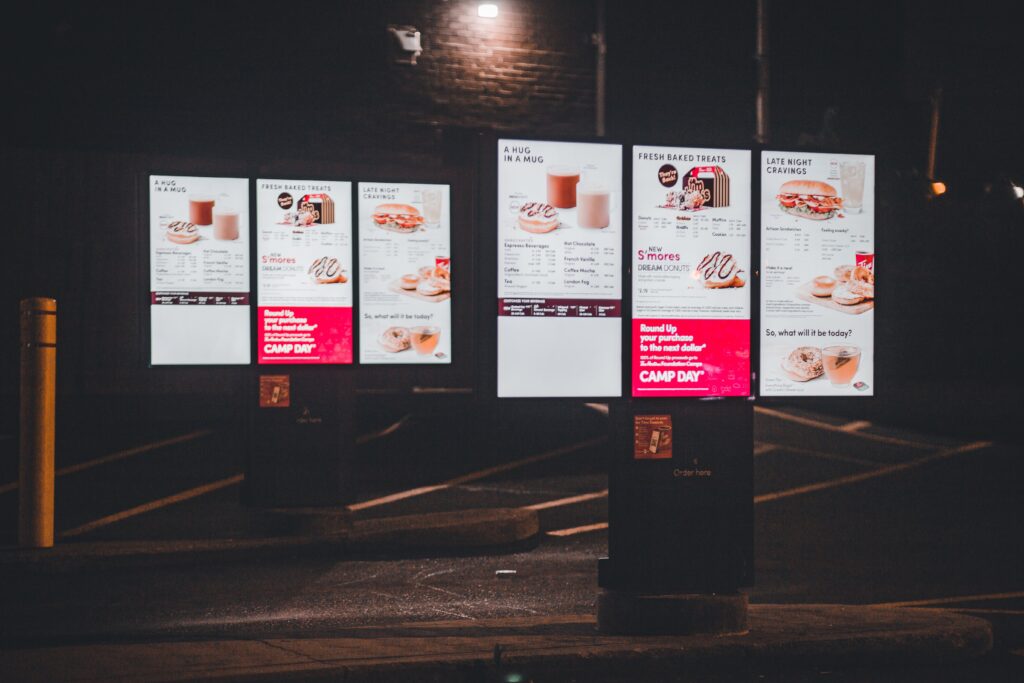
When we talk about effective menu signage in restaurants in Singapore, digital signage pops out in our heads. But the question here is how digital menu signage differs from traditional one.
When a customer enters any restaurant, he will first notice menu signage if we add a digital menu screen that can grab even a passerby’s attention. Hence, it makes a massive difference to restaurant businesses. If you want to grow your customers to your restaurant immensely, you must invest in digital signage rather than traditional menu signs.
To understand deeply, let’s talk about how digital menu signage differs from traditional ones and how it makes a tragic difference to your business. A correct and effective marketing strategy is what you need for your business.
Digital Menu Boards
Digital menu boards are computer-driven. Many restaurants and cafeterias have improved their game and moved to electronic menu boards. Unlike static, non-moving objects, bright, colorful, and animated text stimulates our brains more.
Using the conventional menu boards to draw a customer’s attention takes time and effort. In restaurants, digital menu signage displays on screens of any size and offers information via text, animation, and video content, among other channels.
What benefits do owners of businesses receive from digital menu boards? Let us find out.
- Reduces printing expenses, particularly when adjustments are needed
- Making menu updates and modifications simpler Bright screens and larger text make reading easier for customers
- It provides a range of menus and allows you to click to switch between them.
- High levels of client focus and engagement
- Excellent images and descriptions support customers in choosing what to buy.
- It saves money on paper and labour costs.
In Singapore, many big restaurants have now switched to digital menu signage and have seen a drastic difference in their business. This makes it relevant if you want to see a notable difference in your work. You can opt for digital menu signage over traditional ones.
Digital menu boards are less expensive and require less installation work. But in this age of digitalization, digital menu boards have shown to be a game-changing tactic.
Traditional Menu Boards
For many restaurants in Singapore, traditional or static menu boards are still helpful. Static signage serves both decorative and informative purposes.
These menu boards are less expensive than digital boards and require less installation. There are better options than a digital sign for a restaurant owner who wants to keep the decor consistent while maintaining a certain ambience, such as a diner with a 90s theme.
Traditional menu boards have the following advantages:
- No faults in digital
- No running expenses for digital
- Durability
- Originality of design
Digital vs. Traditional Menu Boards
Both static and digital menu boards provide information. However, in recent times, digital menu boards have developed a revolutionary approach to brand recognition and customer engagement that makes static menu boards hard to compete with.
These are the main distinctions between the two types of signage.
- Cost
Digital menu boards do not have to consider the high cost of printing to produce all visual elements, as traditional menu boards do. The changes can be easily and quickly applied to a digital sign over the computer, saving time and effort compared to reprinting updated menus.
Digital menu boards lower food costs and waste in addition to the cost of materials. This is helpful when considering food expiration or keeping an eye on when ingredients or menu items are running low.
Businesses can avoid waste by having better insight into their stock. By attaining a higher sales margin per transaction, it is possible to take advantage of sales opportunities because menu items don’t run out of stock.
Long-term cost savings can also be achieved by digital menu boards when considering economic scale. Economy scales are cost savings that businesses experience as their output rises. Five to six updates or revisions to the menu boards a year might be necessary, depending on the restaurant and its seasonality.
- User Experience
Customers expect quality and quick acceleration in businesses, and technology makes that happen. A digital menu board increases the probability that customers will definitely visit. It is easier to read when bright screens with readable text are used.
We all get intrigued by the big bright screens and can’t resist reading whatever is written on them. Digital menus can also entertain customers. Customers can pass the time while waiting in line by engaging with content on the screens.
The menu board may offer cross-selling instead of staff members, and customers can inadvertently upsell themselves without feeling compelled.
- Real-time Menu Updating
Employers can program a digital menu board to switch menus at a fixed time of day automatically. There’s no need to swap out lunch menus for dinner menus physically.
Furthermore, altering prices or adding new menu items remotely is now possible. Any internet-connected device, including smartphones, can be used by management to add or change information quickly. Moreover, digital menu boards can be easily updated to conform to recently passed or upcoming health regulations.
With the help of a digital menu board singapore, entering this data is almost hassle-free and keeps the restaurant up-to-date. Additionally, informing customers about calorie intake helps foster a mindset of prioritising health.
- Management
It can get more complicated for a restaurant chain to keep up appearance and operational uniformity across many locations as it gets bigger. There is no assurance that the menus at all locations will look the same when using traditional menu boards.
Because all menus can be updated simultaneously, digital menu boards eliminate uncertainty. This removes disparities in the menu, and a cohesive branding and marketing strategy is produced.
Errors and inefficiencies can also be eliminated with centralized control. Employers can virtually control screens and manage messaging and content via the Internet.
- Visuals
Through creating a personal, one-on-one connection, digital signage attracts customers’ attention and can influence their purchase decisions. Additionally, offers or promotions that boost overall sales can be highlighted on digital menu boards.
This gives a menu board motion and can draw in customers more quickly if video content or automatically generated GIFs are available. However, excessive activity on digital boards can turn off customers.
Customers can find it challenging to focus on the primary message on crowded boards with excessive text or information, so ensuring all content is presented deliberately and strategically is critical.
- Target Audiences
Following multiple viewings of a static menu board, users may lose interest in the content. In addition to displaying regularly updated content, digital billboards allow employers to customize promotions to target specific demographics easily.
For instance, a restaurant close to a high school might run student-only school lunch specials, and this information could be shown while the students are eating.
- Foot Traffic
Efficiency and engagement are increased when interactive screens are used—for instance, a worker rushing through their lunch break. Customers can choose quickly and efficiently without interacting with a human by using a touch screen menu, allowing them to return to work on time. Additionally, this can expedite the turning of tables and welcome more diners.
- ROI
Restaurants in Singapore must continue to innovate to stay competitive in ever-changing markets. A digital menu board will boost a company’s return on investment and almost pay for itself. The relationship between net profits and investment costs is known as ROI.
A company’s return on investment is positively impacted by raising sales margins, taking advantage of seasonal opportunities, encouraging upsell purchases through digital experiences, strengthening brand recognition, and removing the need for static menu printing.
Also Read: Digital Signage Singapore: Procedure, Prices & Reviews
Also Read: Education Signs: Education Digital Signage Services in Singapore
Also Read: Backlit Signage: How To Choose & Price
Create Your Menu Signage in Restaurants in Singapore with SignEagles NOW!
Explore the signage projects that we have completed with dignity and responsibly. SignEagles Signage Company has a skilled team of digital menu signage who will help you design, create, and install your menu board for maximum reach. Contact us for a quote and get exclusive signage offers on your project. GET a FREE Quote Today!